jeannebirdblog

PipLove: A story of tortious interference with an inheritance


Leave a comment

Simplify Your Art

After a summer-soaker rainfall, the silver-flash of the black asphalt driveway sparkles.  I leave the threshold of Nanny’s driveway as the sun shines upon it, step away to start, run, find order, at eighteen-years-old.  I leave Darien High School behind, the little town of Darien, take a deep breath, leave Mom and her lack of order behind, to look for the meaning of my life.

Three teachers’ words follow me as I leave high school.

“Simplify your art,” said Mrs. Light, a jewelry and ceramics teacher.

“Why don’t high school students protest and stand up for something important today?  Why, when I was in school, we protested the Vietnam War!” said Mr. McCarthy, an English teacher, who looked at my class in disgust.

What am I going to protest?  Maybe I should protest that Mom has to sit in a car line at a station for gas, due to the gasoline crisis, which makes her late for her factory job.  Maybe I should protest about Mom’s stress that infiltrates my bones, as she hurries out the door and bitches, “I have to get to work.  I have five mouths to feed,” and leaves my sisters and me to fend for breakfasts, bag lunches, and getting to school ourselves.  Maybe I should protest how, deep down in my bones, I worry over Mom’s burden to support us, how I hate that she sits in a car line, how I hate St. Mary’s Thanksgiving donation of a basket of food that sits on the kitchen table, and of how I hate the person that I am, terrorized by my parents’ battles.  No, none of this is like the Vietnam War.  Someday, please, Dear, Sweet, Jesus, give me something important to protest about.

I sit at my desk in Mr. McCarthy’s class and stare at him, torturous, wiry anger in my throat.  I want to tell him everything, this young teacher with the beard and wide tie, who takes extra time to help me structure a writing assignment, and who writes in my yearbook that he hopes good things happen in my life.  Yet, I can’t do it.  Besides being disgustingly shy, I’d never let the snobby, rich, Darien teens, my classmates, know any more than what they presume about my rent-subsidized life in an Allen O’Neill home.

“Keep writing, Jean, you have something special in you,” wrote Mrs. Marshall, another English teacher, on one of my many stories.

I leave Nanny’s driveway.  I leave the sun-covered sunflowers that surround Uncle Pippi’s garden by summer’s end.  No longer do the flowers tower over my head, as years ago, when Mom paraded my sisters and me around the garden in her divorce march.  I leave this beautiful, simple place that God has given me the gift of knowing.

Note:  Eight years later, with a college degree under my workhorse thumb, a career that circles from New Haven, New York City, to Stamford, I marry, and raise my children, in a very different way from Mom’s way, learning how to love.  Even later in life, lack of order follows Mom, who suffers from Ataxia, meaning “lack of order.”  This is the complete opposite of me, one who wants order.


Leave a comment

Thankful For Who She Is

There is something to be said when a person gives me food for nothing in return.  Gives me nourishment, not only for my body, but for my mind.  The giving rests easy on my soul.  I am thankful for Uncle Pippi giving Mom, my sisters, and me, the vegetables from his garden in our Darien.  Do you know how giving that is, a gift from the dirt?

The tires of my truck roll over Darien roads.  I drive through town with my eyes practically shut, from Stamford, where I live, to Norwalk, where Mom has lived for the past eighteen years.  She is a part of my daily life.

We run errands in our Darien – to the pharmacy, where I get her medication prescriptions, a thrift store, where we check out bargain deals for knick-knacks, a consignment shop, to buy clothes for my children, to Post Corner Pizza, where I lunch with Mom.  Mom, the aging mother that I love, me, the Italian dutiful daughter, parading out our simple lives.

Back at her house, she wraps foil over a tin pie plate of my favorite Italian dish, eggplant parmigiana, and gives it to me as I sit at the kitchen table, fidget with a pill cutter to halve medications and sort them in a pill box for the week.  I go through her mail, take the bills to pay later, wash the dishes in the sink.

“Heat the eggplant up for supper,” said Mom, as I ready to head home.  She is thankful with her food.

“Thanks, Mom.”

I take her gift, knowing that I will not gobble it down, but throw it in the garbage when I get home because it won’t taste good.  She can’t cook like she used to, thinks she can, wants to, because it is who she is.

My stomach, full of dirt-fear for my aging mother, shudders as I gather dirt-courage for the unknown future that I worry about.  With my weaknesses, I try to firmly believe that God has chosen me for this role.  I can take the past’s beatings and betrayals, because Dear, Sweet, Jesus is in me.  I am thankful for that.  I am thankful for my words.


Leave a comment

The Jig Is Up

Barb draws a happy face on a faded-yellow autumn leaf and makes a figure out of leaves and sticks that we’ve collected in our backyard on Seaside Avenue.  Maria draws a green outline around a red maple leaf glued to light blue paper.  My little sisters can be sweet at times, especially now, as they listen to me as I instruct them how to make art out of nature, paper, and crayons.  Art is in me.  Not the type of art that Vincent, a boy in my fourth grade class has, as Sister Ann coos over his drawings.  I’m not as good as he is at drawing, however, I quietly convince myself that the art world is waiting for me.

Years later, in a fit of dangerous fury, when in the down-and-outs, financially and emotionally, I throw away the rolls of film that capture Daddy’s technical drawings as a tool-and-die maker.  He was a machinist who designed jigs, dies, and machine and cutting tools used in manufacturing processes.  Uncle Eddie gave the film to me, as a keepsake of Daddy.  I suppose he didn’t need it to remember Daddy’s art.  I wonder what he thought as he made the decision to give the film to me after saving it for many years.

“The jig is up, Jeanne,” Mom would say, meaning a jig, as in a trick.

I don’t have to wonder about any of it anymore.

With regrets of throwing away the film, I shove the film in my imaginary back pocket, along with Tolstoy’s War and Peace, and Mom’s patch of Uncle Pippi’s garden.  I can take them out whenever I want to and thank Dear, Sweet, Jesus for that and for loving me.  I thank Him for giving me the gift of forgiveness and that I am no longer the judge, the jury, the decision-maker, of Mom’s life.  I am no longer a jig, as in Daddy’s trade, a custom-made tool used to control the motion of another tool.  I thank Him for making me an artisan of peace.


Leave a comment

CORNERED

Mom’s wicked witch hands are all over me.

It started at the kitchen table.

“Hurry up and eat and go to bed,” said Mom.

My sisters and I silently go at bowls of spaghetti in our Seaside Avenue yellow kitchen.  Mom painted the room yellow because she likes a yellow kitchen.  I think any color paint will help this 1890-built, one-family house that’s cut up into three, small apartments with walls that jut out weirdly and too many doors that lead to a hallway.

Donna sits across from me, Barb’s next to her, and Maria’s next to me.  Mom ranks the head of the table, near Barb and Maria.  These are our steady positions in the new place we call home after Daddy and Mom’s recent divorce.  A round, wooden clock hangs over the pantry door, of which I sit opposite.  I can see a bag of potatoes on the pantry floor, blue Ronzoni boxes of pasta, Sclafani canned tomatoes, and Campbell soup cans on the shelves.  They are nice and neat, put in order by me.

I look at Mom, watch her, wonder what’s up, what’s her bad mood all about this time.

“What’re you looking at?”

“Stop staring at me.”

“I said, stop staring at me!”

I don’t answer her, look down at my bowl.  Yet, I can’t help myself.  I steal sneaks at her as I twirl spaghetti on a fork that hovers over a spoon.  Grandpa taught me this trick of how to eat spaghetti.

My last look does it to Mom.

“Dear Mary, Mother of God, so help me,” said Mom.

She’s up in a hot-flash, black, angry eyes race, goes past Maria, to me.  As soon as Mom is up, I’m up, run around the table to the other side, then caught by the hair, trapped between the fridge and a short wall that sticks out near the stove.  There’s no escape.  I am cornered.

Mom’s wicked witch hands are all over me.

The only thing that I can do is back against the wall, crouch as low as possible, make myself small, and shield my head and face with my arms and hands, as her hurting hands slap me, every which way.  To bear the stings, I go down deep inside myself and wait, wait, wait, until the beating is over.  My being is small, small, small, at the core of my physical body.

My sisters sit frozen at the table.

“Go sit down and finish your supper,” said Mom.

In my chair, I pick up the fork, but that’s about all I can do.  I stare at the clock on the wall above Donna’s head and try to hold in a ropey mess in my throat of sobs and tears.

“Now she’s doing it to Donna,” said Mom.

I can feel her eyes on me.  I dare not look.  She’s riled up and wants to keep at it.

“No, she’s not!”

A silent thanks to my sister, I keep my eyes on the bowl, my long, dark hair hides my red-streaked cheeks.


Leave a comment

Best Friend

Sometimes, I don’t know who is my best friend.  Sometimes, my best friend is LoLa, an Italian girl who lives in a house around the corner, a Victorian with a creamy-colored rooftop, spirally like an ice cream cone.  We hold hands, skip along Elm Street, to our first-grade class at St. Mary’s school.

Sometimes, my best friend is our grey-striped tomcat, Twinkles.  Behind Joshu’s rocking chair, on the upstairs porch, I crouch and stroke him as he lay still at my feet.

“God, why are Daddy and Mom so mean to me?  What did I do wrong?  Why don’t they love me?”

His big, gray eyes glue to my eyes, he listens, twitches a peaked ear, and his soft, sweet, friendship assuages little girl talk of confusion, prayer, and tears.


Leave a comment

Firebrand Hotheads

“My stomach is in knots,” said Mom, as she took her dinner plate and scraped the roast beef, mashed potatoes, and green beans into the garbage can.  She can’t eat because of us four girls.  Hell, teenage times are tough.  Isn’t easy raising three, fiery teens and one on the cusp.

I feel so responsible for her pain and I just don’t know how to fix, help, heal her.

I wish I could take off on a sparrow’s back and fast-fly the hell out of here.


Leave a comment

The Defensive Nature Of My Introverted Nature

Daddy gives my sisters and me nicknames when we’re little girls.

Donna, Happy-Go-Lucky.

Jeanne, Smartie.

Barbara, Hot Shot.

Maria, Mona Lisa.

Whether or not we believe it, the elephant in the room, impossible to overlook, is that Daddy truly loved us.  The elephant that I can’t talk about is Daddy.

“He was a drunk,” said Mom.  She slams the pink elephant book on him.

“Jeanne, you’re the only one that has unconditional love for him,” said Barbara.

Stick up for Mom.  Always.  Don’t talk about Daddy.  Never.

“I saved you girls from Jefferson Street,” said Mom.  This is an obvious truth.  The elephant is banished.

Yet, the only one who truly saves me is Mother Mary.

The nicknames follow us in life, even when I see the Mom that I miss when she peeps out, now and then, in a dementia unit of a nursing home.  Mom tells Maria that she’ll always hold a special place for her in her heart.  I’m over the top about this because my Mona Lisa princess sister needs to hear it.  Barbara struts her stuff, holds Mom’s hand, tells her that she loves her, in her Hot Shot way.  Donna gives out a Happy-Go-Lucky vibe as she teases her son into kissing Mom.  Mom smiles.  Mom tells me that she missed me years ago, when I was away at Smartie college.  How I wish she had told me then, at the time I needed it most.

When I was a teen, Mom said that I should be more like Donna, Happy-Go-Lucky, put a smile on my face, instead of a frown, let things roll off my shoulder.

Through my thin skin, a weight sits in my cord-knotted stomach when Mom talks like that.  The elephant is in my throat.  I can’t speak, or defend myself, wonder why Mom wants me to be more like my sister and what was wrong with me, the way that I am.

The way that I am.  Smartie.

The nickname takes me back.  Daddy plays games with my sisters and me.  We’re in the kitchen, where aproned Mom cooks yummy gravy, spaghetti, and meatballs, for Sunday dinner.  The kitchen smells good, like an Italian restaurant.

“Your mother’s the best cook,” said Daddy.

He keeps us out of Mom’s hair, sits on a chair, Barbara, Maria, and I henpeck around him as we lead him in a beauty parlor game.  He lets us brush his hair with Mom’s pink hairbrush.  We use her black bobby pins to curl Daddy’s hair, in the way that Mom does her hair, but the pins slip-slide to the floor, which crack us up.  In another game, with a quarter hidden in his fist, he gives us turns at guessing which hand the coin is in.  I get it right every time.

“Smartie,” he says, unconditionally.

“Look ahead, don’t look back, hold onto your dreams,” said Mom.

The torpedoed teenager mess in my head spins in divorce trauma, welfare, mom-beats-me-because-she-does-not-like-the-way-I-look-at-her, subsidized housing, mom-rips-my-clothes-out-of-the-closet-because-she-does-not-like-the-way-I-hang-them, rich Darien, no money, embarrassment, no memories, ugly words, why-don’t-you-just-marry-your-boyfriend-and-get-the-hell-out, housework sweat, no help, can’t-use-the-dryer-so-towels-freeze-on-the-clothesline, crippling shyness, yells, don’t-bother-Uncle-Pippi, wild wooden spoon smacks, school stress, shame, endless fear, have-another-of-Aunt-LaLa’s-Italian-cookies, squashed feelings, say-your-prayers-at-bedtime, mow-the-lawn-and-car-drivers-pass-by-and-stare-at-my-tshirted-chest, screams, mom-beats-me-because-I-crack-up-her-car, slaps, pinches, bruises, always-be-friends-with-your-sisters, swear words, mom’s-pink-hard-hairbrush-hits-my-shoulder, violent fights, you-can’t-do-anything-right, fuck, fuck, fuck, mom-says-she-has-no-one-to-help-her-but-me-burdens.

Smartie doesn’t work so well in those days.

Once in awhile, I sneak into Mom’s bedroom and search in a dresser to be reminded of my nickname and what it was like to have a Daddy.  It’s a good thing that Daddy recorded the nicknames on paper, in a drawing for Mom.  With colorful pencils, he drew his daughters and taped a black and white photo of each of us, taken in Woolworth’s photo booth, above our portraits.  We have beautiful smiles and the most hopeful eyes.  A headline, in his technical block hand-lettering, above each girl, lists an item number.  I am Number 2, as I’m the second-oldest.  We are all required in his recipe as he wrote, “Mix four items together and bake well:  WOW!  Happy Anniversary.  Love, Joe.”    Below each girl’s image are our nicknames.  In a corner, compass arrows with a question mark symbolize what item number might be next in their family dreams.

Over the years, I ask Mom if I can have the drawing, a marriage memento, but she says no.  She keeps it in a drawer of what used to be Daddy’s dresser.  When I’m in my thirties, Mom finally gives me the drawing.  It is in fragile condition.

“I know you appreciate old things, Jeanne, and that you’ll take care of it,” said Mom.

It is the sweetest wedding anniversary present that I have ever seen.

In the nursing home, I show Mom my wedding album, family photos, a Noroton Heights history book, and photos of her grandfather and brother, Pippi, as a Darien high school football star.  The weight in my stomach is here as I search for clues, reasons, answers, on how to live up to my know-it-all nickname and for God’s directions to my happiness.

Smartie investigations give the answer key to many questions.

Now I know that Mom tried, at times, in kindness, to lighten the elephant with her roundabout nature.  She didn’t get that I have to look back to look ahead.  I hold onto dreams.  Not her way.  My way.  In a reoccurring dream, I am dutifully connected to Daddy and Mom with a strong, white cord.  I have to go where they go.  The cord is fragmented and weakened with Mom’s death.

Dreams, dreams, dreams.  With a call to joy, my mother-in-law spelled me with dream interpretations to find answers.  Years spirit by.  I investigate a dream where the elephant in the room comes to me.  An elephant is in my yard, to clear away debris, from the sidewalk installation that occurs in true life.  He clears away leaves and twigs near a dogwood tree.  He helps me clear away the mess.  He is friendly and I don’t fear him at all.  He is thick-skinned and lets things roll off his shoulder.  The elephant speaks for God’s power to remove obstacles.  I offer the elephant an apple, as though it’s a present for a teacher.

Through investigation, I gather that the defensive nature of an elephant may represent an introverted nature.  Elephants symbolize inner strength, wisdom, memory.  The power of persistence.  It depicts the power of the unconscious with a conscious direction to achieve wonderful things.  So, it is the totality of self rather than awareness of only the conscious ego.  In Christianity, this is the Holy Spirit, the influence that heals, instructs, guides us to truth.  If you feed an elephant in your dream, you are elevated through kindness.  If the elephant is friendly, you will have good luck in what you are undertaking to do.  If the elephant is doing a job, you will have success above your wildest dreams.  I don’t believe in dreams, still, I learn that if you are seeking answers, the elephant symbolizes the key to knowledge and truth.  You will be told the answer.


Leave a comment

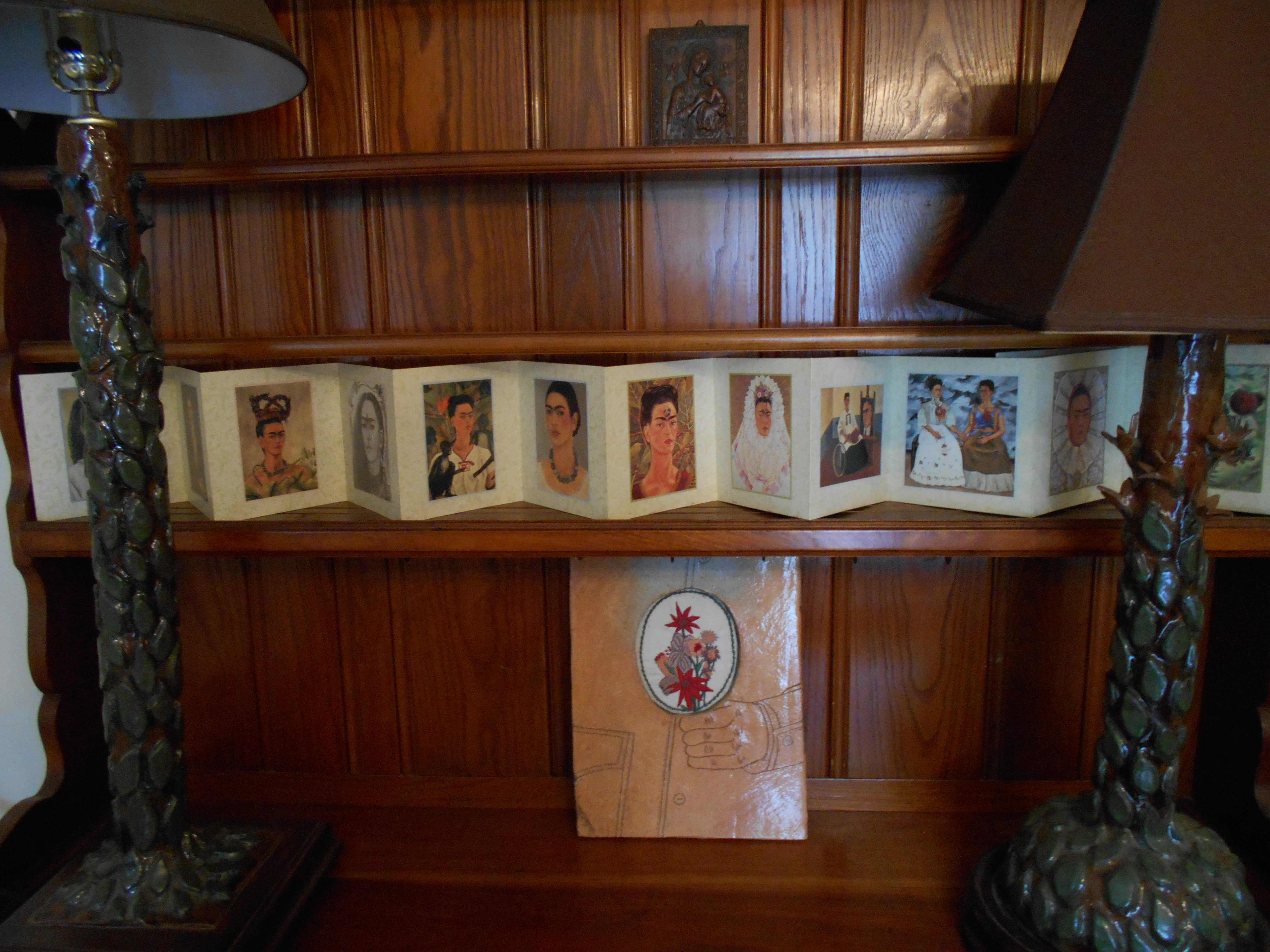
My Frida Kahlo Altar

Frida Kahlo was a woman artist of persevering strength, worshipped by me.

From top to bottom:

Victorian beeswax plaque of Mother & Child.  (Unknown artist).

Accordian pull-out of Kahlo’s self-portraits.

Ceramic plaque with flower embroidery.  (Jean, 1980)

Ceramic lamps, leaf pattern.  (Jean, 1980).

Art saves lives.

Kahlo altar 004


2 Comments

Silly

Daddy watches me as I imagine he sits on the brick front porch of my house.  His clear, blue-green gemstone eyes twinkle as he joyfully chuckles to see me.  I know his laugh.  He wears a Mom-iron-pressed white shirt, sleeves rolled up, collar unbuttoned, white t-shirt peeps out, beige trousers, neatly cuffed at the ankles, all 1950s vintage clothing now.

Silly, I think, I know, I dream.  Silly, old me.  He’s gone over thirty years, yet I feel his presence still, in wistful moments, as I pass by the porch to throw the trash to the curb in the early morning light, or walk up the drive to the kitchen door in the twilight of the soft sky at the end of the day, when night is just beginning.  Daddy is in twilight, a state of my childhood cloudiness, waning in my mind.

His gemstone eyes will never see my children, one with eyes the color of a cloudless blue summer sky, one with eyes the color of the deep, ocean blue.  They are the gems of my eye.  They would have been his, too.

“Hello, Daddy,”  I say, waving to the porch to resurrect him.

Wistful moments wondering what could have been, what should have been, what wasted wishes got rollered over by his phantom alcoholic twists-and-turns that made him abandon me and my sisters.  A spiritual resurrection comes late in life as pain lets go of wondering what to say about Daddy, how to tell about Daddy, how not to be embarrassed and hurt over Daddy, of letting go of the crumpled cursed tears of what I imagine are a daddy’s moments with my first date, high school report cards, college maneuvers, wedding aisle, father-and-daughter dance, first house, first baby, first, first, first.

With my spiritual resurrection and after Mom’s gone, I reunite my parents on my front porch.  They don’t fight as in the old days.  She sits close to him as in their early days of lustful love.

Those were ugly, the old days of fighting that fell between blessed spells.

Hateful, shuddering screams over just about anything fill our house.  Mom’s yell to Daddy to get the hell out often ends fights, as he goes his way, to Tony’s liquor store, to the Colony Bar and Grill, his brother’s house, or to god only knows where else.

“He’s an alcoholic,” said Mom, her only explanation, as if I know what that means.

Many fights are about money.  No, all fights are about money.  I think money is more valuable than me.  It is scary when they fight.  Why don’t they know how I feel and why don’t they just shut the hell up?

With one fight, the remains of Daddy’s business, a jewelry-making shop, are on the kitchen table.  In the gem-polishing business, friction is key.  In madness, Daddy grabs a box filled with aquamarine, garnet, opal, ruby, emerald, and amethyst gemstones, throws open the kitchen’s back door, and out on the porch, slings the box to the backyard.  The gems sail, skitter-scatter, settle in the grass.  As in so many of his starts-and-stops, Daddy abandons Joseph’s Jewelers, then cuts and runs from the house.

Mom orders Donna and me to collect the gems.  I use my eagle eyes to find them in the summer-green grass, turn it into a game, guess how many feet the distance is from where Daddy stood on the porch, to how far he could throw, and how much flexed muscle force is needed to make gems fly.  I think of hunting for Easter eggs, Jesus’ candy jewels in the grass.  I find a lot more gems than Donna does and tell her so.

Instead of doing this, instead of wondering what is so important about these shimmering gems to make my parents act the way they do, instead of trying to figure things out, I want to push my dolly in her carriage, ride a tricycle, pet the cat, jump rope, roll about and watch ants, pluck-and-suck sweet blossoms from the honey suckle bush, all things a six-year-old girl should do, not shudder-shake a scare in my stomach.

“Did you get all of them, Jeanne?” asks Mom.  We dump the precious gems into her cupped hands.

I silently nod yes.

“Can’t we leave Daddy and go and live with Nanny?” hiccups Donna, out of a blue dream.

Mom hands my sister a napkin to dry her tears.

“No, that’s just silly,” said Mom.